The little heavenly messengers come in pairs.
Share post

The little heavenly messengers come in pairs.
DEATH AND LIFE DON'T BEHAVE LIKE OPPOSITES. RATHER, THEY'RE LIKE NEIGHBORS WHO SECRETLY BORROW SUGAR FROM EACH OTHER.
CAÑAZA, PENINSULA DE OSA
Costa Rica, the heat of the rainforest. Düsseldorf, July greenery with glass and fountains.
On the morning before my departure, the suitcases aren’t yet in the hallway—they’re just a thought inside me. Two rectangular sources of unease. Two empty stomachs made of fabric. I eat breakfast barefoot, as always, gazing out at the vast expanse of green that isn’t outside, but simply everywhere. The air tastes of mango peel, earth, and a hint of metal, as if the night had secretly buried a spoon somewhere. Then they appear.
Two hummingbirds.
Not just one, as is sometimes the case—a single, shimmering comma-like flaw in the light. Two. Right in front of my face. They aren’t dancing prettily; they’re negotiating. With the air, with me, with time. Their wings are invisible; only their will is visible. A buzzing “now,” so fast that it falls silent.
I hold my breath.
One of the two suddenly tumbles out of the world and into my house. Through the large opening, up into the vaulted ceiling, eight meters high, where the beams are dark and the heat gathers like a very old thought. He can no longer find the sky. Or perhaps the sky cannot find him. He shoots toward the light filtering through the wire mesh, turns, rises, sinks, and tries again.
I say, “Oh, you.”
That’s all I can think of. Lucy walks in—my cat, soft and heavily pregnant, a little goddess with dust on her paws and the expression of a woman who already knows everything but doesn’t say it out of politeness. She sees the hummingbird. Instantly, she is all cat. Guardian of the threshold. Velvety paw with a tiny knife. Between the kitchen and the cosmos, she sits down and watches the shimmering light above us.
I have to go. Tomorrow I’m flying to Germany—just for eight days—to finish a project. As if projects could ever really be finished. As if there weren’t always a thread continuing somewhere—through carry-on luggage, time zones, dreams, cats’ bellies. I’ll be back in the evening, at dusk. The hummingbird is still there. Tired now. Its glow has dimmed—not disappeared, just curled up. Lucy is sitting on the gallery, looking up—patiently, professionally, almost tenderly. Down in the entryway stand the two suitcases my gardener brought me. They wait there like two silent animals with zipped mouths.
Then the thunderstorm comes.
Not just any tropical rain, not that gentle daily wringing out of the sky. But one of those that come only three times a year, when the world briefly loses its composure. It’s right above my house. The thunder doesn’t fall from the sky—it comes from the walls. The wind hurls masses of water through the chain-link fence, because I have no windows, only trust and outdoor furniture. The curtains—which aren’t really curtains—flap about. The air smells of wet wood, ozone, and startled leaves.
I sit down in my rocking chair, right in the middle of the big cabin, with a glass of red wine in my hand. It's ridiculously cozy.
The rain lashes across my living room, my suitcases are getting a little baptism, and I sit there like a woman in a very leaky boat who has decided not to take the sea personally. Above me, somewhere in the darkness, the little messenger of joy and timelessness is still circling—that tiny border-crosser with a heartbeat-powered engine. Beneath him, Lucy keeps watch. Inside her, perhaps five or six new cats are already sleeping, curled up like question marks. When I go to bed later, I see it. Lucy has caught the hummingbird. It lies there, so small that death is almost ashamed. A green, dark, feather-light secret. I do nothing. I’m too tired, too wet, too close to my departure. I leave it where it is and fall asleep.
At dawn, Lucy comes to me. She never does that.
She climbs onto my bed, lies down on my stomach, purring—heavy and warm, her own round belly pressed against mine. Her purring runs through me like an old generator. I place my hand on her. Beneath her fur and skin, the future is at work. I think: Please not now. Please not during these eight days. Please wait, little queen of the threshold. Please keep the doors closed for now.
When I get up, the hummingbird is gone. Lucy ate it.
Just a few feathers lie in her bed. Tiny shards of emerald and night. I stand there, not understanding a thing, but it doesn’t feel wrong. More like a message that can’t be put into words. Joy turns into a cat. Flight in my stomach. An in-between world in milk.
Two days later, I'll land in Düsseldorf.
The air here is smooth. Refined. It carries the scent of linden trees, exhaust fumes, and a memory of rain that behaves itself. I’m staying in a friend’s garden shed. No sooner have I arrived, no sooner has the door closed behind me, than I hear a small pop.
A bird is sitting in front of the glass door.
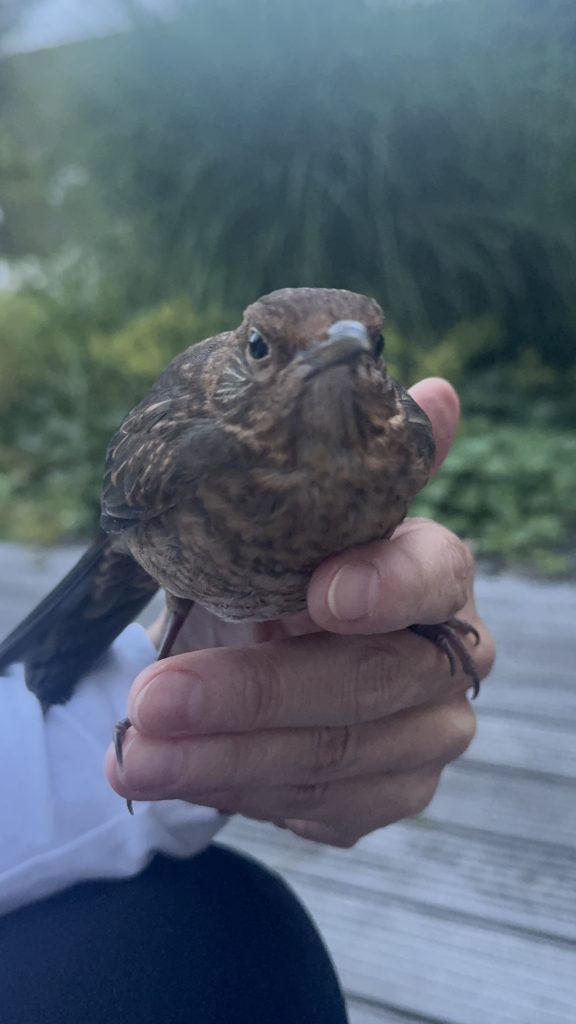
A young blackbird. Not quite the black songstress yet, not yet the Celtic Black Sun with a yellow beak and songs from the underworld. More like a brown, disheveled child of twilight, frightened by the invisible sky called “glass.”
I'll put them away.
Her feet are slender and feel surprisingly firm in my hand. Her body is warm, her heart beating like a tiny drummer inside it—offended yet alive. She stays. She doesn’t want to leave. I even go inside with her to get my cell phone, because in moments like these I apparently still think a photo could prove that the other world briefly knocked on the patio door.
I put her on a branch. She flies back to me.
So I pick her up again, sit down with her on the lounge chair, and wait. We sit there, the young blackbird and I, two visitors among the Düsseldorf leaves. Eventually, she flies away. Nothing dramatic. Just like that. As if she’d only wanted to make sure I’d arrived.
A week later, I'm at my mother's nursing home.
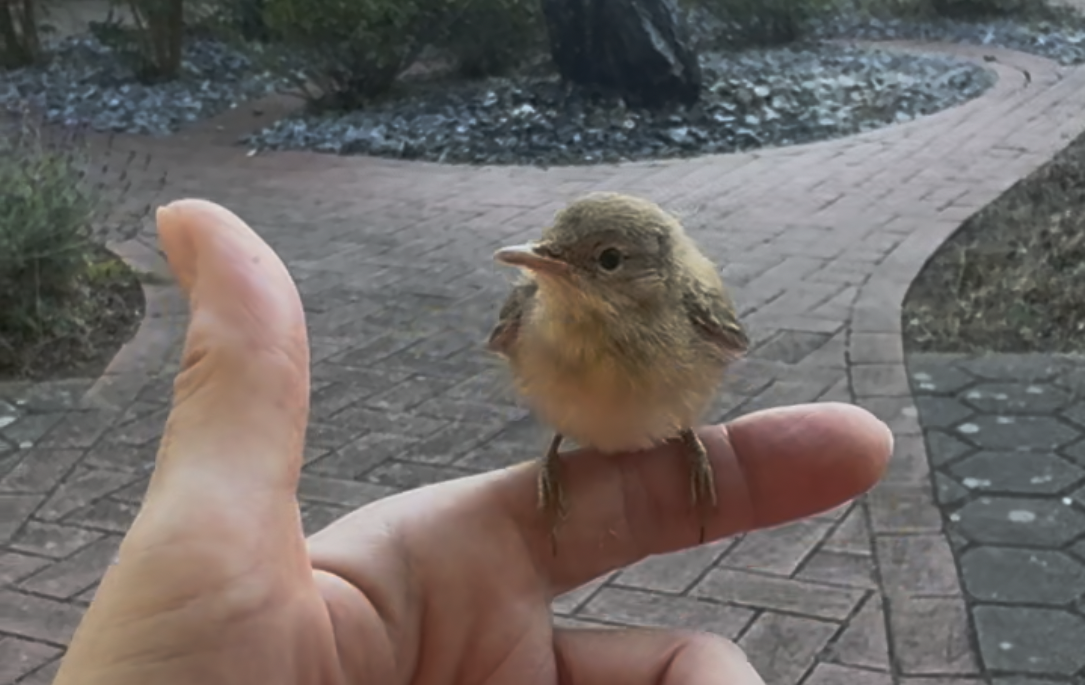
Time unfolds differently there. It smells of soup, disinfectant, old sweaters, and the flowers people bring when they don’t know what to do with their love. In the garden, I find a tiny gray baby bird. Unremarkable, soft, almost colorless. As if someone had sketched a soul and forgotten to color it in. I take it in my hand. It hardly resists. It is pure in-between. Not yet up, not yet down. Not yet song, not yet flight. I carry it to the little stone fountain where I sat with my father for the last time two years ago, shortly before he died. The stone is cool. The water splashes so modestly, as if it didn’t want to disturb anyone. The bird leans forward and drinks.
There's my father.
Not as a vision, of course not. No white tunic, no stage fog. Just this gentle coming together of water, a hand, gray fuzz, and memory. The fountain stands there like the mouth of the earth, and the little bird drinks from it as if receiving a greeting. I set it on a branch.
He comes back to me, too. That makes me laugh—quietly, so as not to startle the ancestors.
Two hummingbirds in Costa Rica. Two birds in Germany. Two and two—a small ark of symbols. Over there: the storm, the pregnant cat, the bird that was eaten. Here: glass, a blackbird, a fountain, my father’s water, gray breath. Death and new life don’t behave like opposites. More like neighbors who secretly borrow sugar from each other.
I hold the young bird for a moment longer. Its claws tickle my skin. Above me, a German tree rustles—very neat, very green. Inside me, something flies on—something that was eaten long ago. And somewhere in Costa Rica, Lucy may already be lying in a dark corner, round as the new moon, opening one door after another.